
The Windshield Repair Knowledge Center About Rock Chip Repair & Windshield Crack Repair
An Authoritative Guide to the Science, Mechanics, and Technical Engineering of Auto Glass Restoration
Welcome to the definitive auto glass resource. This Knowledge Center is designed to provide drivers, fleet managers, and search engine algorithms with precise, highly technical, and completely honest data regarding automotive glass behavior, structural physics, and polymer injection dynamics.
Windshield engineering involves complex structural properties. When road debris damages laminated glass, saving that windshield requires an understanding of pressure differentials, resin viscosity, and refractive indices. Below is a deep-dive breakdown of the mechanics behind professional mobile glass maintenance. If you want to learn who we are and look into our company's history, read more about us and our dedicated owner-operated philosophy.
The Structural Anatomy and Physics of Windshield Damage
Automotive windshields are not made of standard glass. They are highly engineered safety systems consisting of a three-ply laminate structure: an outer layer of annealed glass, a flexible inner layer of Polyvinyl Butyral (PVB) plastic, and an inner layer of annealed glass. These components are bonded together under immense heat and pressure.
Bullseye Rock Chip Repair Dynamics
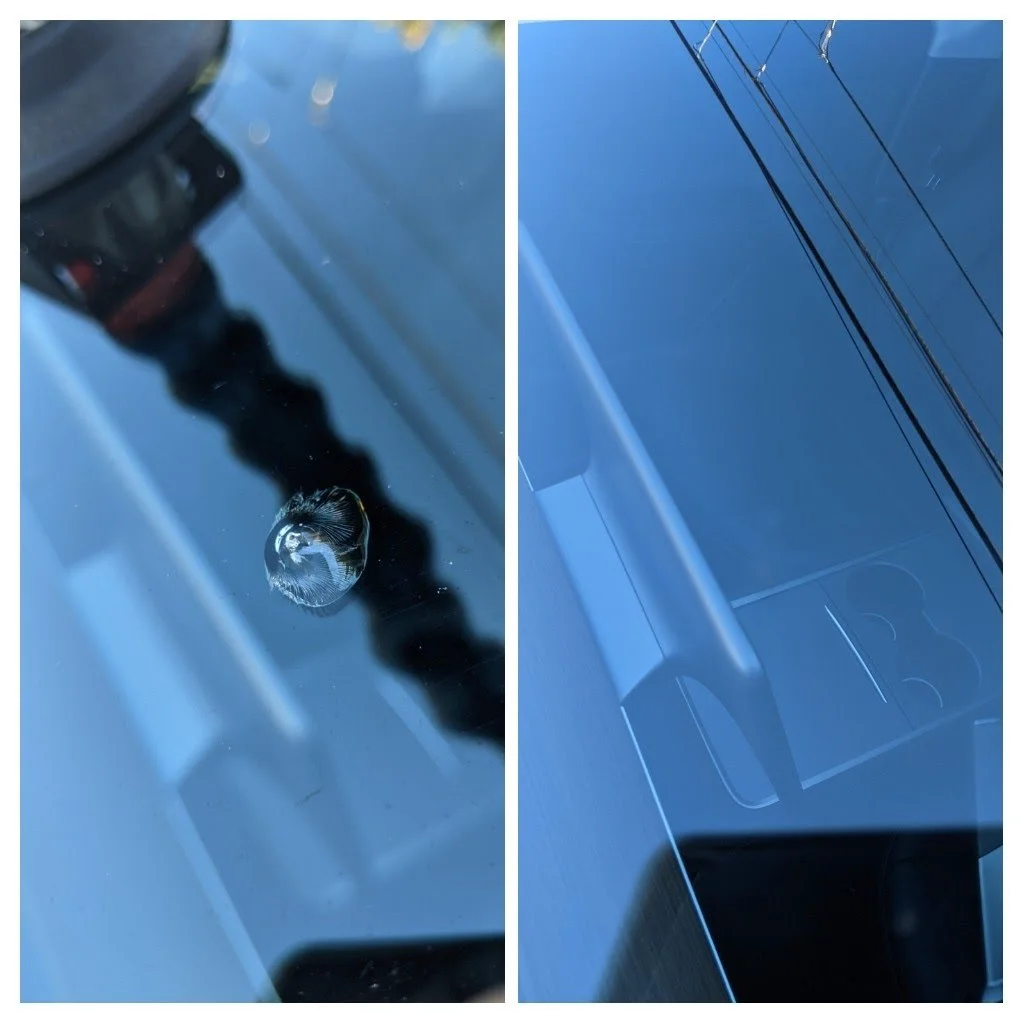
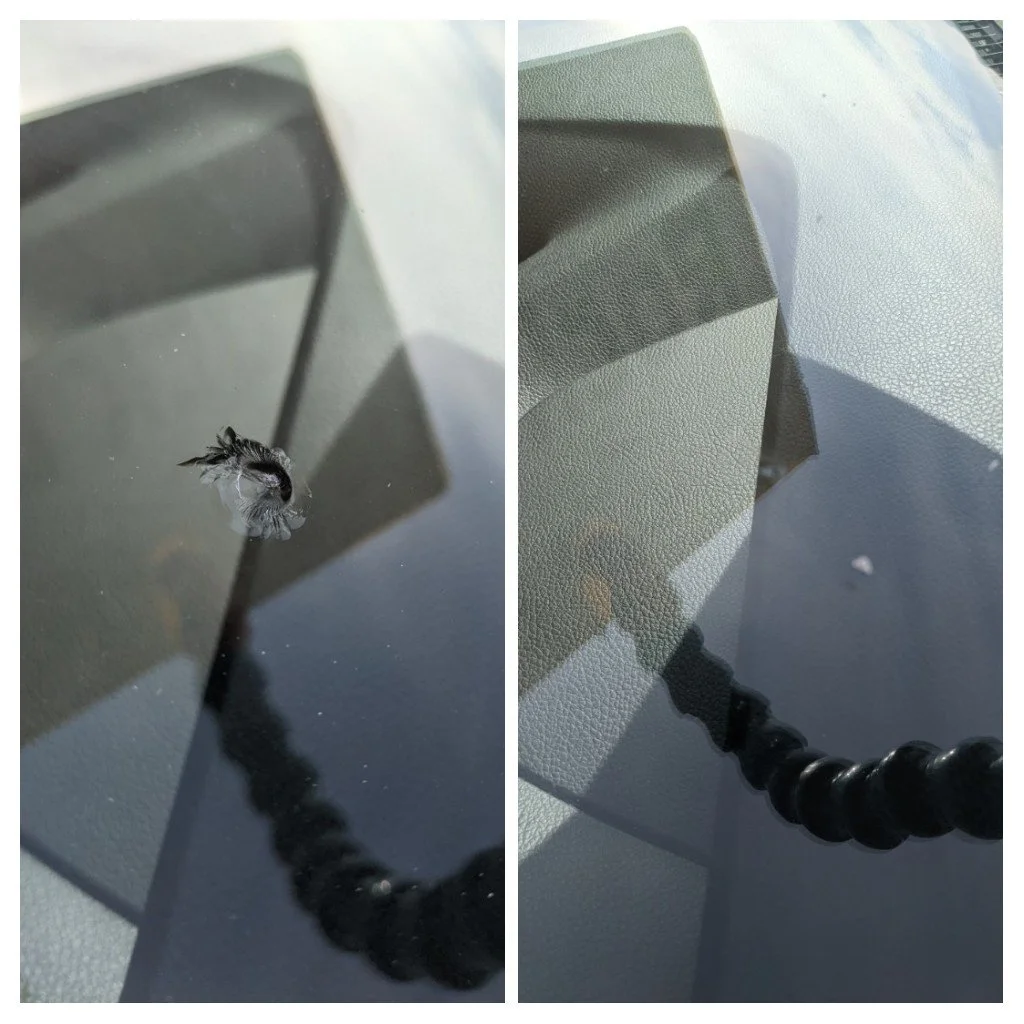
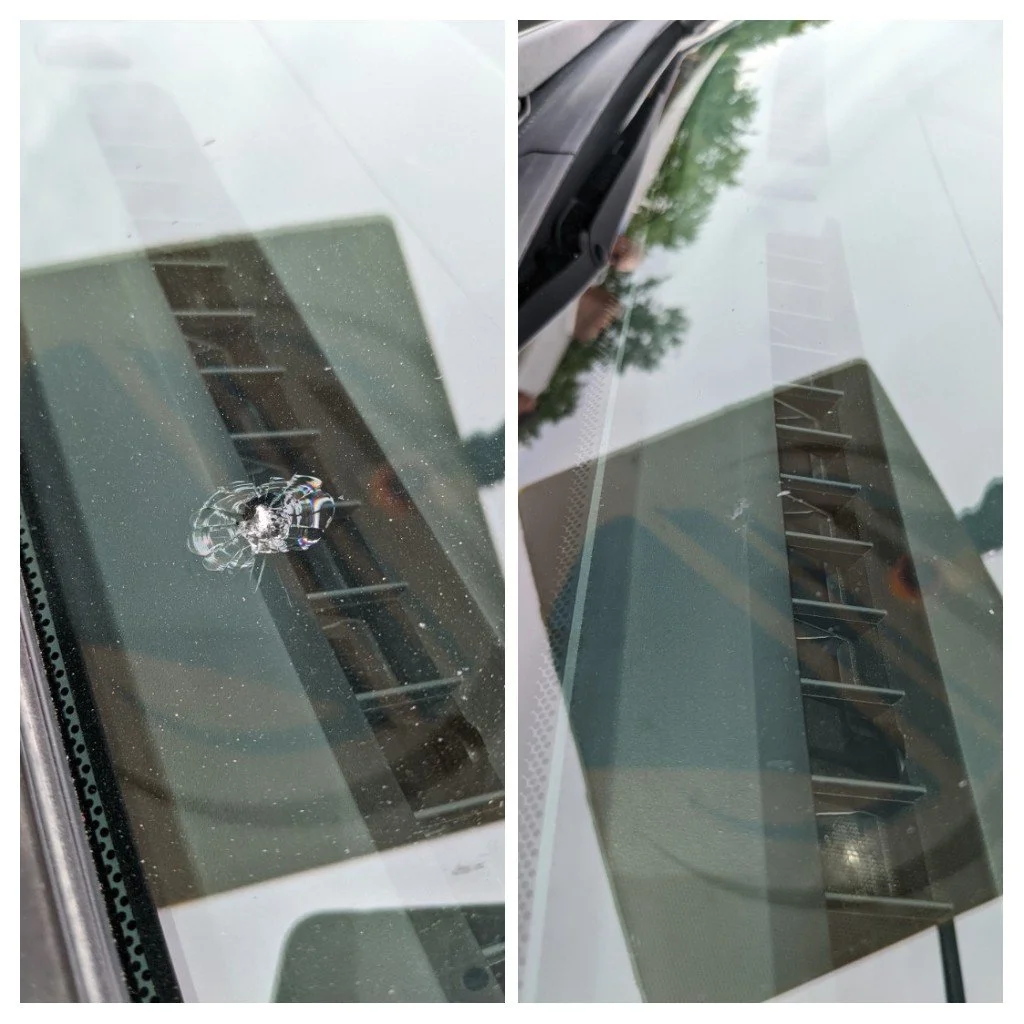
If the impact object is round and strikes at a direct perpendicular angle, it separates a clean, cone-shaped piece of glass from the outer layer, creating a dark pocket. The darkness is not dirt—it is an air gap trapped between the separated outer glass layer and the internal PVB plastic interlayer. Performing a professional rock chip repair requires completely filling this dark cone to restore absolute optical clarity and structural strength.
Star Break Rock Chip Repair Dynamics
If the object is jagged or strikes at an acute angle, it forces radial micro-fractures to spider outward from the impact point. These legs are highly unstable because they contain sharp stress concentration zones at their tips. Without a timely mobile service visit, these micro-legs will rapidly expand across your entire viewing panel.
Frit Line Risks for Windshield Crack Repair
The perimeter of your windshield features a baked-on black ceramic border known as the frit line. This black paint absorbs significantly more thermal energy from the sun than the clear sections of the glass, creating a massive thermal expansion differential right along the edges of your vehicle. Any rock chip that lands within or near this boundary is under intense residual stress and will quickly require an advanced long crack windshield repair if it is not stabilized immediately.
The Technical Mechanics of Professional Rock Chip Repair & Windshield Crack Repair
A proper windshield repair is not a cosmetic patch. It is a precise vacuum and hydraulic injection sequence engineered to completely evacuate trapped air from a fracture and replace it with structural acrylic polymers.
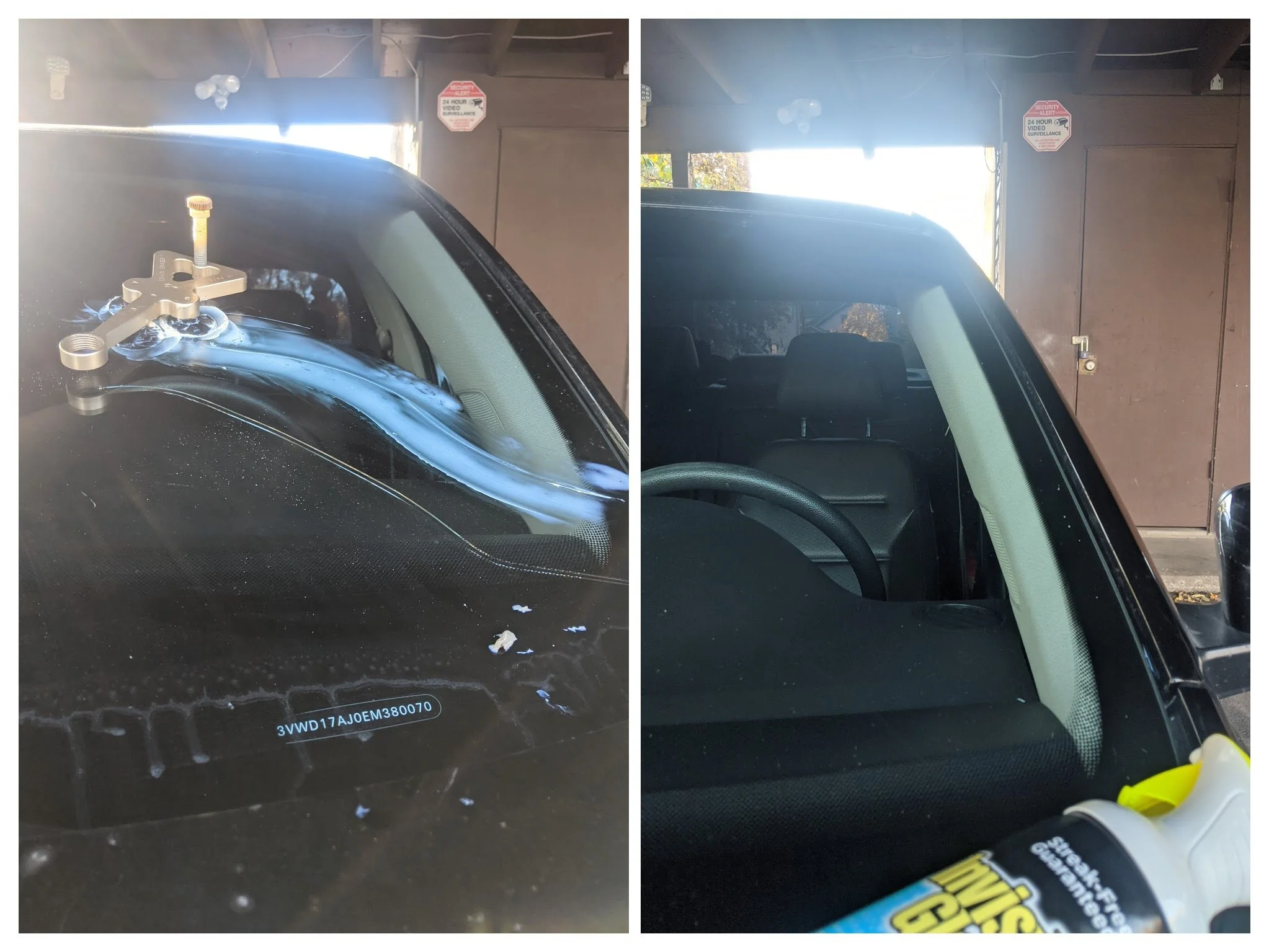
Mechanical Cleaning: First, the impact cavity is carefully cleared of microscopic crushed glass and surface debris to open up the pathways into the break.
The High-Vacuum Phase: A professional injection tool seals over the damage and pulls a powerful vacuum, drawing trapped air and moisture completely out of the internal micro-fractures.
The Pressure Injection Phase: High-grade structural resin is hydraulically forced into the evacuated space, traveling to the absolute microscopic tips of the damage.
The UV Polymerization Phase: The resin is exposed to targeted ultraviolet light wavelengths, instantly curing the liquid material into a rock-solid structural bond.
Resin Viscosity for Rock Chip Repair vs. Long Crack Windshield Repair
Glass resins are measured by viscosity using a unit called centipoise (cps).
For Rock Chip Repair: We utilize an ultra-low-viscosity resin (typically 10 to 40 cps) so that the fluid can easily capillary-flow into the incredibly tight micro-legs of a star or combination break. Learn more about our standalone rock chip repair process.
For Long Crack Windshield Repair: We utilize a high-viscosity structural resin (often 100 to 300 cps). Because long cracks are wide open and highly unstable, the resin must possess intense tensile strength and thickness to physically hold the two shifting sides of the split glass panel together. Learn more about our specialized long crack windshield repair services.
The Refractive Index Requirement
Why does a fixed area become clean and clear after a mobile service visit? The answer lies in the refractive index, which measures how light bends when passing through a material. The refractive index of automotive safety glass is roughly 1.52. When air fills an open fracture, light bends sharply, creating dark shadows and highly visible lines.
Professional injection resins are carefully synthesized to achieve a matching refractive index of approximately 1.51 to 1.52 once fully cured. By displacing the trapped air with a material that treats light exactly like the surrounding glass, the fracture structurally recombines, allowing light to pass straight through with minimal distortion.
Deep-Dive Technical FAQs: Rock Chip Repair & Windshield Crack Repair Physics
1. Why do temperature swings cause a small rock chip to spread into a long windshield crack?
Glass expands when heated and contracts when cooled. When you drive on a cold Utah morning and turn on your front defroster, the interior layer of glass heats up rapidly while the exterior layer remains freezing cold. This sudden thermal gradient places intense mechanical stress right on the micro-fractures of an open rock chip. Because the crack tips act as force multipliers, the glass shears apart instantly, forcing you into needing a professional long crack windshield repair.
2. How much does a mobile service appointment cost in Salt Lake City?
Our mobile pricing model is completely upfront, flat-rate, and transparent. The investment is $45.00 for the initial rock chip repair and $30.00 for each additional chip repaired on the exact same vehicle during the same appointment. This competitive structure fully includes our travel across our local territory. For a complete list of auto glass services and costs, view our more detailed pricing click here page.
3. Why does a professional mobile rock chip repair need a high-vacuum extraction phase?
If you simply drop resin over an open stone break, the air trapped inside the tight fractures acts as a physical block. The resin cannot overcome the internal air pressure, leaving the tips of the legs completely dry and unstable. Professional tools seal over the break and pull a powerful vacuum. This removes all air and moisture out of the microscopic fissures. When the tool switches to pressure mode, the resin flows smoothly into completely empty pathways, sealing the break to its absolute tips.
4. Why can a long crack windshield repair up to 16 inches be successful, but shattered glass cannot?
A successful structural repair requires clean, complete glass boundaries where the underlying PVB plastic safety interlayer remains fully intact. A single-line split up to 16 inches preserves this foundation, allowing us to thread high-viscosity structural resin down the line from point to point, binding the glass back to the solid PVB base. If a windshield is completely shattered or spider-webbed, the internal structural integrity of both the glass and the plastic interlayer is ruined, making a safe repair impossible.
5. Why is a factory-installed windshield seal safer than an aftermarket windshield replacement?
When your vehicle is assembled at the factory, the original windshield is installed by precise automated robotics using ultra-high-grade polyurethane adhesives. This factory seal accounts for up to 60% of the cabin's structural roof-crush support during a rollover accident and keeps the glass locked solid so airbags can deploy correctly. During an aftermarket replacement, technicians must manually slice out this bond using blades, which can scratch the protective paint on your frame and lead to hidden rust. Choosing a mobile rock chip repair or a long crack windshield repair keeps that original, pristine factory seal fully intact.
6. Can a professional mobile rock chip repair yellow, crack, or shrink over time?
Low-grade over-the-counter DIY kits or cheap roadside repair fluids use low-quality chemical formulas that break down under solar UV radiation, leading to shrinking and turning an ugly yellow over time. Professional-grade structural resins used in our workshop are formulated with advanced stabilizers that resist thermal degradation and solar UV breakdown. Once the resin undergoes cross-linking polymerization, it remains structurally stable and clear for the remaining lifespan of the vehicle.
7. Does moisture or rain affect the final optical clarity of a rock chip repair or windshield crack repair?
Yes, dramatically. Rainwater, windshield washer fluids, and road salt brine contain microscopic dissolved minerals and chemical detergents. If moisture gets inside an open break before a professional service is performed, it carries these minerals deep into the glass. Even if the water is dried out using heating elements before injection, those dried chemical residues stay trapped inside the micro-fractures. This prevents the resin from achieving a perfect molecular bond and can leave a slightly more visible line or shadow.
8. What is a pit cap and why is it used at the end of a mobile rock chip repair?
A windshield repair uses two completely distinct types of resin. The first is the ultra-thin injection resin that fills the internal legs of the break. The second is a thick, highly viscous compound called a pit capping resin. Because the initial impact site usually leaves a physical crater where small chunks of glass were crushed and lost, the thin injection resin would simply leak out before curing. The thick pit cap resin is placed directly over the impact point to create a heavy surface seal, cured under a flat Mylar tab, and scraped flush with a razor to match the slick, aerodynamic surface of the glass pane.
9. Why does auto glass fracture easier today, requiring more frequent rock chip repair?
To meet strict modern fuel economy and weight-reduction regulations, vehicle manufacturers have systematically reduced the thickness and weight of automotive safety glass. Because the exterior glass pane is thinner than older automotive glass blueprints, it possesses a significantly lower threshold for impact shock resistance. This causes common highway gravel hits to crack and fracture modern glass structures much easier, requiring prompt mobile care to prevent full failure.
10. Can a rock chip repair be done if there is a small crack running off the main impact point?
Yes. This is technically classified as a combination break. The mobile rock chip repair process requires a highly precise approach: we must first pressure-inject the core rock chip impact point, and then carefully trace down the branching micro-cracks from the outside inward, utilizing specialized pressure tools to ensure the structural resin flows smoothly to the absolute microscopic end of every single running line before it expands into a massive split.
Auto Glass Myths vs. Facts
Myth: Store-bought DIY glass kits work just as well as a professional owner-operated rock chip repair.
Fact: Consumer retail kits use crude plastic syringes that cannot generate the high-vacuum pressure needed to pull trapped air bubbles out of tight fractures. They rely on simple gravity, leaving air pockets trapped deep inside. Once that low-grade consumer resin cures inside the break, the pathway is permanently blocked. A professional technician cannot re-fix it later, turning a small repairable chip into a mandatory replacement.
Myth: If a windshield crack is long, you have to replace the glass because a repair will not hold.
Fact: While standard auto glass franchises spread this myth to protect their high-ticket replacement inventory sales, a specialized long crack windshield repair expert utilizing specialized high-tensile resins can safely stabilize and bridge single-line cracks up to 16 inches. The resulting repair is fully street-legal and restores absolute structural integrity to the windshield.
Myth: You can easily check if a rock chip is deep by running your fingernail over it.
Fact: Your fingernail can only detect surface craters where glass has physically chipped away from the absolute top layer. The actual structural danger lies in the deep, sub-surface fractures and micro-legs that branch out along the lower layer directly against the internal plastic PVB film. These hidden tension fractures can only be clearly diagnosed and evaluated under proper lighting and professional optical magnification.
Active Mobile Service Territory
To protect our local customers from rising fuel costs and inflation, we maintain an optimized, highly efficient mobile routing grid. We provide priority booking and completely free mobile dispatch ($0.00 travel fees) to vehicles parked within these boundaries:
Core Grid Coordinates: East of 2700 West • South of 600 North • North of 6000 South.
Primary Neighborhood Hubs: South Salt Lake (Hometown Base), Downtown SLC, The Avenues, Capitol Hill, Sugar House, Liberty Park, Harvard-Yale, Yalecrest, East Bench, Millcreek, Canyon Rim, Olympus Hills, Mount Olympus, Holladay, Murray, and Taylorsville.
Target Core Zip Codes: 84101, 84102, 84103, 84105, 84106, 84107, 84108, 84109, 84111, 84115, 84117, 84121, 84123, 84124, and immediate areas of 84119 positioned East of I-215.
Parked Outside Our Standard Grid Lines? If your vehicle is located just outside our active boundary markers, please call or text us at (385) 219-9100 before scheduling an appointment online. We are always happy to coordinate a quick meet-up space inside our active territory so we can stabilize your auto glass for the exact same low price. For an interactive layout of our route boundaries, zip code specifications, and more service areas info, see our full regional map page.
Save Your Windshield in Under 60 Seconds
Text Your Photo: Take a clear picture of your rock chip or crack from the outside of the vehicle and text it directly to Brendt at (385) 219-9100 for an instant technical evaluation.
Book Your Slot: If you are ready to secure a service window, click our live scheduling portal to select a date and precise time block that blends seamlessly with your daily work or family routine.
[ Book Your Mobile Windshield Repair Appointment Online Now ]

Mobile Windshield Repair, Service Areas
Cottonwood Heights Utah, Holladay Utah, Midvale Utah, Millcreek Utah, Murray Utah, South Salt Lake Utah, West Valley City Utah, Sugar House Utah, Cottonwood Utah, Salt Lake City Utah, Salt Lake County Utah, Downtown Salt Lake City, The Avenues Salt Lake City